
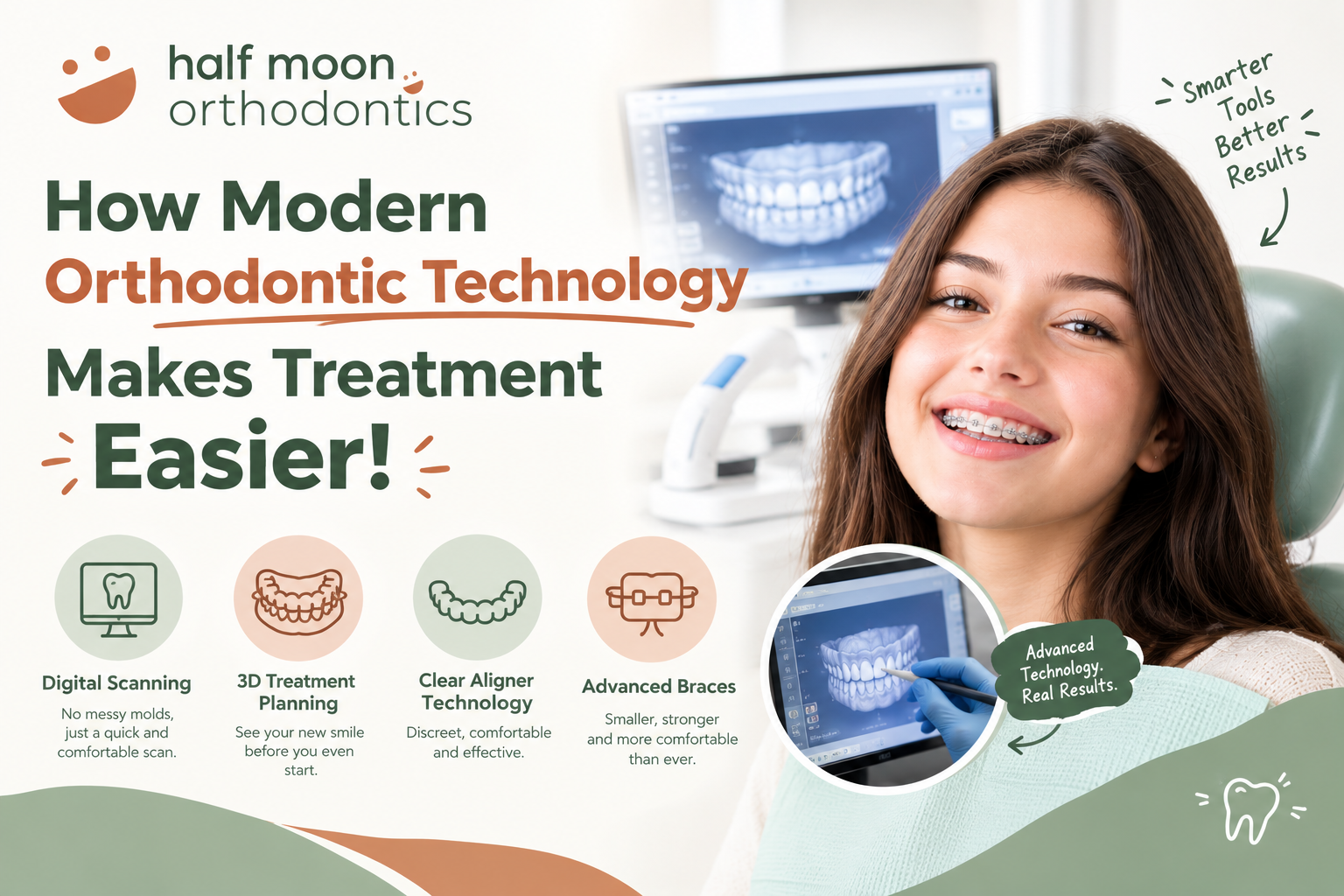
Modern orthodontic technology simplifies treatment by speeding up each step. It is more comfortable and more accurate. Digital scanners replace sticky putty, and the 3D images provide a complete picture of your teeth and jaw. And the computer software plans every tooth movement. At the end of treatment, you will spend less time guessing and more time moving toward a healthier, more confident smile. In this article, we will explain how these tools work, how they can enhance orthodontic treatment for children, teens, and adults, and what they cannot do.
The Role of Digital Technology in Modern Orthodontics
Digital technology helps orthodontists plan, track, and modify treatment with far greater accuracy than plaster models ever allowed. Now, our professional team works with 3D files that show every tooth in detail. They also make progress easy to compare from the initial visit to the final result.
The American Association of Orthodontists (AAO) reported in its 2024 census that the average number of patients in active treatment per member was 696. It is clearly up from 574 in 2022. As demand is growing, the purpose of these digital tools is to enable clinics to maintain quality without rushing anyone.
Key Tools at a Glance
Tool |
What It Does |
How It Helps You |
| Intraoral scanner | It captures a 3D model of your teeth | There will be no putty and fewer retakes |
| 3D imaging (CBCT) | It shows roots, jawbone, and facial structure | It makes more detailed planning possible |
| Clear aligners | It helps move teeth with removable trays. | There’ll be fewer metal parts, and it’s easier to clean |
| 3D printing | With this help, we make models, trays, and aligners from scans | There will be shorter waits between steps |
| Remote monitoring | It helps to track progress through app photos | Fewer daily office appointments |
How 3D Digital Scanning Works
A 3D digital scan works by moving a small wand over your teeth. It captures a stream of images. The software then joins them into one detailed 3D model. This process typically requires only a few minutes. And if the scan misses a spot, the orthodontist simply rescans that area rather than redoing the whole impression. According to Align Technology, more than 12 million iTero digital scans were performed in the first quarter of 2026 alone. This shows how typical this method has become.
Digital Impressions vs. Traditional Dental Impressions
Digital impressions are faster and more comfortable than traditional dental impressions. They also help reduce repeats. Traditional impressions require a putty-filled tray that sets in your mouth. This can trigger a gag reflex. Digital scans skip that step entirely. Below, we will compare these simple steps.
Feature |
Traditional Impression |
Digital Scan |
| Materials | Trays filled with putty | Small handheld wand |
| Comfort | Can trigger gagging | No putty or tray needed |
| Chair time | Several minutes, plus setting time | Usually a few minutes |
| Retakes | Often the whole impression | Only the missed area |
| Sharing | Physical models sent to a lab | Files sent instantly |
Using 3D Imaging for More Detailed Treatment Planning
3D imaging lets orthodontists see the full structure of your tooth roots, jawbones, and facial structure. But a flat X-ray can’t show this. Cone beam computed tomography (CBCT) is the most common type of imaging. For example, it can help you find impacted teeth and check root position, but it is not required for every patient. So your orthodontist uses it only when he needs extra details for the treatment. Another benefit of advanced machines is that they use lower radiation than a typical medical CT scan. This supports careful and targeted use.
How Digital Treatment Planning Helps Customise Care
Digital treatment planning helps personalize care by allowing your orthodontist to map each tooth’s movement from start to finish on a computer. The app displays your teeth’s current location, their intended location, and the intermediate steps. The plan may then be adjusted by your orthodontist to suit your schedule, goals, and bite. Additionally, several systems allow you to preview the expected result. So you know the goal before the first aligner or bracket is applied.
Clear Aligners and Computer-Guided Treatment

Clear aligners use computer-guided plans to slowly shift your teeth with a series of removable plastic trays. Each tray addresses one small step in the plan, and you switch to the next one on schedule. Invisalign trays use SmartTrack material. They are specially designed to fit comfortably and apply steady pressure. According to Align Technology, as of 30 June 2026, almost 23 million individuals worldwide had received Invisalign treatment.
Braces Have Improved Too
Traditional braces have also changed. Self-ligating braces use built-in sliding clips instead of elastic ties, which lowers friction and often means gentler adjustments. Likewise, heat-activated nickel-titanium wires respond to body heat and apply light, steady pressure instead of sudden tightening. Together, these upgrades can make braces more comfortable.
The Role of 3D Printing in Orthodontics
Orthodontists can use 3D printing to produce models, aligners, and bonding trays from your digital scan, often without waiting for an outside lab. For example, indirect bonding trays help place brackets in the planned spot with less guesswork. In many situations, this means shorter waits between your scan and the start of treatment.
How Technology Can Improve the Patient Experience
It improves the patient experience by reducing discomfort, saving time, and simplifying each step. Scans are fast, plans are displayed on a screen, and many changes feel more delicate.
Fewer Visits With Remote Monitoring
Some doctors use smartphone apps that allow patients to upload weekly progress photos or short videos. By reviewing these, your orthodontist can detect issues early. This can help reduce the number of in-person visits.
What Modern Orthodontic Technology Can and Cannot Do
It can make treatment more accurate and comfortable. But it cannot replace an orthodontist’s judgment or guarantee a specific finish date. Scans and software reveal the plan, but your teeth still move at a biological pace. If you want excellent results, you must follow the treatment plan, wear aligners as directed, care for braces, and attend checkups. Also, complicated cases may take longer, and not every tool is right for everyone.
Frequently Asked Questions
What technology is used in modern orthodontics?
These technologies are used in modern orthodontics, which includes intraoral scanners, 3D imaging, treatment-planning software, clear aligners, self-ligating braces, heat-activated wires, 3D printers, and remote monitoring apps.
Are digital dental scans more comfortable than traditional impressions?
Digital scans are typically more comfortable. Because they skip the putty and trays that can cause gagging.
How are 3D scans used in orthodontic treatment?
3D scans produce a detailed model of your teeth. Your orthodontist uses them to plan tooth movement, design aligners or trays, and track progress over time.
Can orthodontic technology make treatment faster?
Technology can do some steps quickly. It can speed up steps like taking impressions and starting treatment. But total treatment time still depends on your teeth. It is also based on your consistency with the treatment plan.
How does digital technology improve treatment planning?
It allows your orthodontist to see the expected result. It tests each tooth’s path and lets your orthodontist quickly modify the plan. In the end, you will have less guesswork from start to finish.
Final Thoughts
In conclusion, modern orthodontic technology makes treatment simpler. It includes fast 3D scans, full digital imaging, digitally assisted dental planning, and transparent aligners. It also offers improved braces, 3D printing, and more frequent visits. All of it improves accuracy and comfort. But only when it is used with a skilled orthodontist.
At Halfmoon Orthodontics, we offer comfortable, effective, and affordable care by using modern technology. Are you ready to learn how these tools can help? Just book your consultation with us right now.

Dr. Ronak Mody
Dr. Ronak Mody is committed to providing exceptional orthodontic care for patients of all ages. We use the latest technology to create personalized treatment plans with clear aligners, metal braces, and clear braces — all in a fun, comfortable environment.
Book a Free Consult
Half Moon Orthodontics
Smiles to the Moon and Back!
Quality, affordable orthodontic care for the whole family in Lake Forest, CA.
Book Free Consult
Leave a Reply